
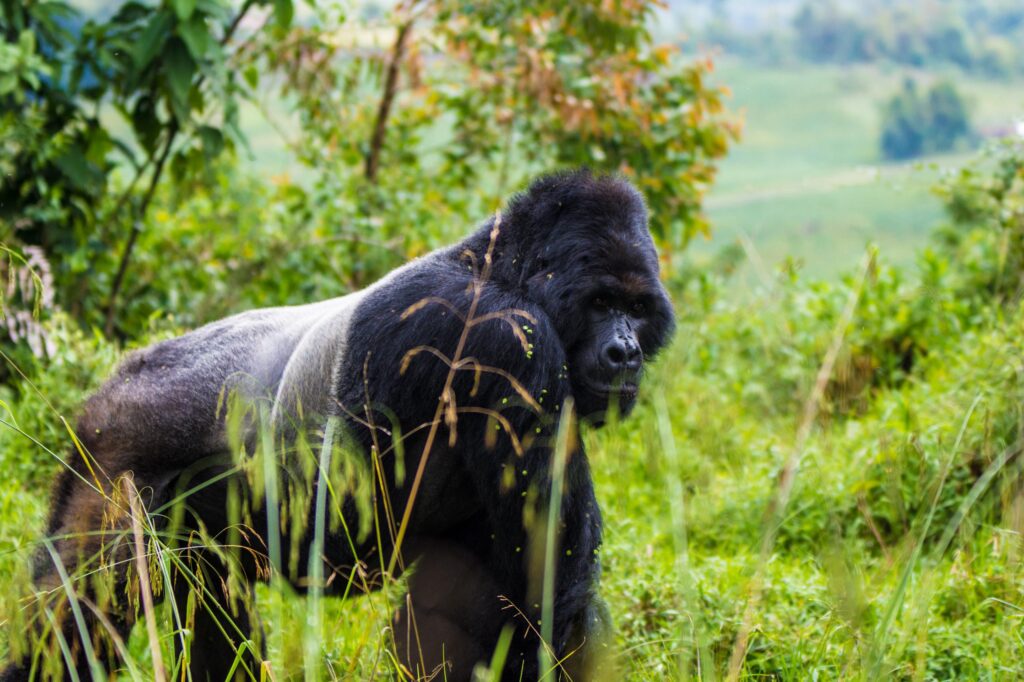
Where Can You Track Gorillas in Rwanda?
Rwanda is home to the famous Volcanoes National Park, where Dian Fossey conducted her groundbreaking gorilla research. The park sits just a two-hour drive from Kigali International Airport, making it the most accessible gorilla tracking destination in the world. Its lush bamboo forests and dramatic volcanoes offer a stunning backdrop for trekking.
Rwanda’s gorilla trekking experience is known for being well-organized, highly structured, and conservation-driven. Visitors often praise the short travel distances, luxury lodge options, and the efficiency of park authorities. Because of Rwanda’s strong focus on conservation and premium tourism, gorilla trekking here is typically seen as a high-end experience.
Where Can You Track Gorillas in Uganda?
Uganda offers two gorilla trekking destinations: Bwindi Impenetrable National Park and Mgahinga Gorilla National Park. Bwindi is the more popular of the two, known for its dense rainforest, rugged terrain, and high number of habituated gorilla families.
The trek in Uganda tends to be more adventurous because of the thick vegetation and steep inclines, but this is also part of what makes the experience so deeply rewarding. Trekkers often recall the thrilling moment when they first spot the gorillas peeking through the vines or relaxing in the shadows of giant trees.
While Uganda’s experience can involve longer tracking times, sometimes between 2 to 6 hours, the encounter with the gorillas is equally magical. Uganda also has more gorilla families than Rwanda, which means better availability of permits.
Gorilla Trekking Permits: Rwanda vs. Uganda
One of the biggest differences between the two countries is the permit price.
Rwanda’s permit is positioned as a premium, luxury product.
Uganda’s permit is more budget-friendly and is often the reason many travellers choose Uganda.
Regardless of where you go, the permit includes guides, trackers, and one full hour with a habituated gorilla family. The price difference does not affect the quality of your interaction with the gorillas; they are equally impressive and protected in both countries.
Because permits are limited and in high demand, especially during peak seasons (June–September and December–February), booking at least 3–6 months in advance is recommended.
How Difficult Is Gorilla Trekking?
The difficulty level varies, but travellers should be prepared for moderate physical activity. In both countries, treks can last anywhere from 1 to 6 hours depending on the movement of the gorillas.
Rwanda Trekking Difficulty
Terrain is more open and less dense.
Trails are generally shorter and easier.
Ideal for travellers with limited mobility or tight schedules.
Uganda Trekking Difficulty
Trails can be steeper and thicker due to the “impenetrable” forest.
Offers a more rugged, adventurous experience.
Perfect for travellers seeking an authentic jungle trek.
Regardless of the destination, porters are available at an affordable fee and can be incredibly helpful during the hike.
What is the Gorilla Encounter Like?
Your encounter begins the moment you step into the forest. Guided by rangers and trackers, you follow paths through misty vegetation, listening for clues such as broken branches or distant calls. When you finally meet the gorilla family, everything becomes still.
You may see a massive silverback keeping watch, playful juveniles tumbling in the undergrowth, or mothers gently nursing their babies. For an entire hour, you stand just a few meters away, observing their social bonds and quiet power. It feels almost spiritual, one of those rare moments that stays with you forever.
Which Country Offers the Better Experience?
There’s no simple answer, it depends on what type of experience you want.
Choose Rwanda if:
You prefer shorter travel times and easy access.
You want a more luxury-oriented safari experience.
You’re willing to pay a premium for convenience and exclusivity.
Choose Uganda if:
You are looking for a more budget-friendly adventure.
You enjoy challenging hikes and dense jungle terrain.
You want more time to explore additional parks like Queen Elizabeth or Murchison Falls.
Many travellers even choose to combine both countries, taking advantage of the East African Tourist Visa to explore Uganda’s diverse wildlife and Rwanda’s cultural richness in one trip.
What You Need to Know
Whether you track gorillas in Rwanda, Uganda, or both, the experience is nothing short of extraordinary. You walk through ancient forests, breathe in the pure mountain air, and lock eyes with creatures that embody the spirit of the wild. Few wildlife encounters can match the emotional impact of standing just a few meters from a mountain gorilla.
So, can you go gorilla tracking in Rwanda and Uganda?
Yes, and you absolutely should. Both destinations offer safe, well-managed, and unforgettable encounters with one of the world’s most endangered and captivating species.
 +256 776 360824